The village with the beautiful name Končita in the green but poor region Orava consists of five wooden houses. The only way to get there is through the pastures, the road stops at the foot of the hill. When we arrive, the place is deserted so we can scoop around without the crazy man trying to chase us away. The crazy man of the village is one of the two brothers who are not talking with each other. Nobody knows exactly why, but they even took turns in taking care of their old father to make sure they did not have to meet each other. When their old father died, they refused to sell the house. They didn't want the other brother to get half of the money.
They carried out the stiff body of their father and closed the door one year ago. When we entered the house, we found it exactly as they left it: shoes next to the bed, wood by the fireplace, toothbrush in a cup by the sink. Because they refused to cooperate to fix the roof before the winter, the roof collapsed under two meters of snow and the house is covered with a blanket of grey mudd. So are his is grey shirts, neatly hanging in the cupboard, and his hat still waiting for him, hanging by the door.
(pictures follow)
Tuesday, July 04, 2006

Wednesday, June 07, 2006
Bells for Suzanna
 The funeral of Susana in Zazriva, Orava, june 2006
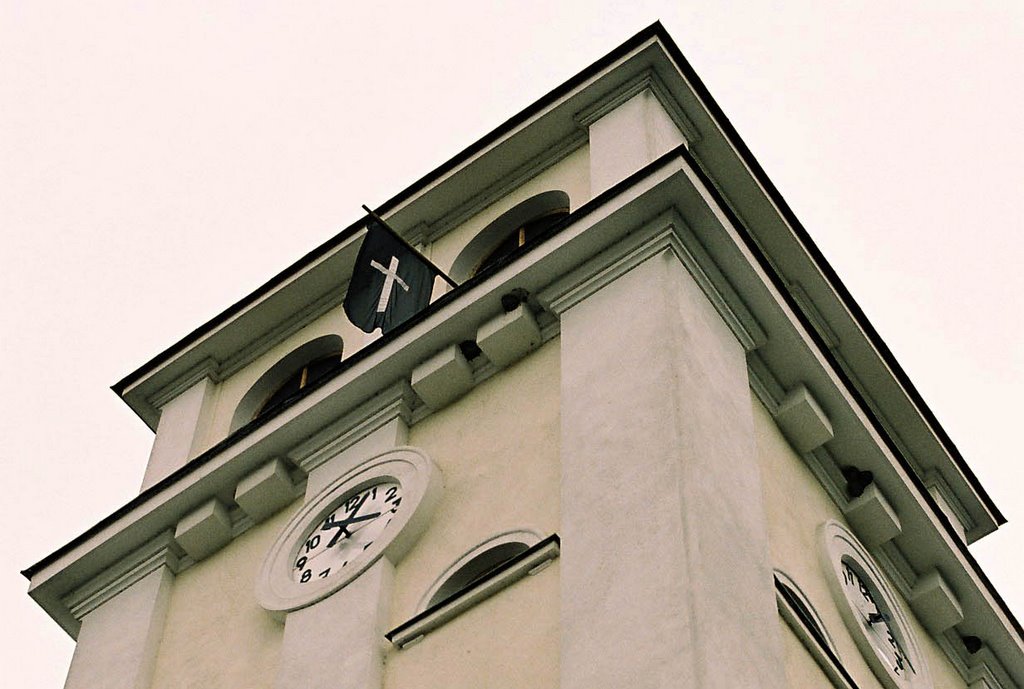
The day the bells rang for Suzanna, the the black flag hung from the churchtower. The sky was grey and the church was packed. Filled with old women with firm black shoes under their black dresses and young mothers with dyed blond hair folding their hands quietly on their laps. The altar boys looked so serious, bringing the coffin to the grave, wearing nike air max under their white dresses.

strange cabbage

At ten in the morning we were warmly welcomed by a sweet couple on their farm. While pouring us glasses of extremely strong Borovicka, the young mother of five children complained that with 15 children in the village it was sometimes difficult to see which ones were hers. She laughed much at her own stories, especially the one of when her husband tried to make pictures of their children one day, but forgot to put in the film. The husband, quietly leaning against their house, was occupied with another story, that puzzled him. A year ago this Dutch company bought some land in the rainy, cold aerea of Orava. Now they were growing something strange there. A green, big leafed vegetable, somewhat like cabbage.... I was so surprised to realise that the biggest lovers of white cabbage (the Slovaks eat it with every meal, as a salad, with christmas, as a soup, the leftovers as breakfast, they simply love it!), had no idea that this strange cabbage they were talking about was nothing less than: Boerenkool. The popular Dutch green farmers cabbage we like to mix with potatoes.
ritual
.jpg)
Twenty years ago, this man lost his wife. Since then his life has been the same everyday, everyday repeating the same ritual. In the morning he goes to the pub, drinks Borovicka untill he can't walk straight anymore, tries to crawl up the hill to his house singing the same song every day, eats his rolls and bacon and falls asleep. In the afternoon he starts all over again. I found him at 10.30 in the morning on the main road of U Stredie, not able to stand up anymore, dragging his breadrolls through the mudd.

Down Town
.jpg)
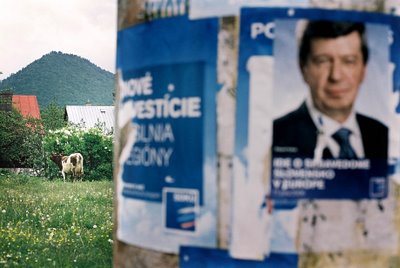
On a normal friday afternoon in the centre of Zázrivá life is full of everyday small-town life. Dogs bark, people move from their house to the shop and later the bar. The unemployed pay their weekly duty to clean up the cemetery. Suddenly the loudspeakers attached to the streetlights everywhere in the town start to produce the static sound of classical music. Followed by the announcement that 83 year old Susana changed her earthly life for the eternal. Tomorrow at two o'clock the funeral will take place. The concrete pillars by the side of the road wear posters of the upcoming national elections in far away Bratislava. Ironically enough this place is known as U Stredie, meaning something like 'in the middle', referring to politics in communist times.

.0.jpg)
a Man's world...
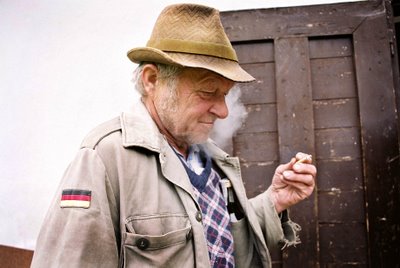
In the villages around Zazriva in Orava, the men have little to live for. No woman to marry, no education to go to the city, just the work that can be done on the land and the Borovicka that has to be drunk. (a kind of jenever) The more Borovicka, the less work they do. Why work more, if you can live on a piece of bread and bacon a Borovicka in the morning and a few at night?
.jpg)

Monday, May 01, 2006
Middle of Europe

Close to Kremnica, a former mining town, is a monument at the place the Slovaks call "Middle of Europe" (Stred Europy). Interesting fact is that Slovenia as well as Hungary have something similar to this monument and all claim to be the centre of Europe as well. While everybody in the western part of Europe considers these countries the 'far east' of our civilisation, it shows that thinking about what Europe is still in movement. This is also visible in the Lonely Planet guide we have on this region. The old one is called Eastern Europe, the brand new one they changed into Central Europe.
Schoolbus Osciadnica

In the schoolbus from Osciadnica, in the Kysuce mountain aerea of Slovakia life takes place like in every safe place on this planet. The old women sits with the driver in the front, suspiciously keeping an eye on the cool kids who are playing card on the last row. The shy ones try to be invisible by staring out of the window.


Tuesday, April 04, 2006


.jpg)
.jpg)
.jpg)
.0.jpg)

Strong heart
 Widow in the tree, Ziar nad Hranom, 2006
I was sitting in a pizzeria in Ziar nad Hranom, a small city without a centre, when I saw this woman in the tree. At first she refused to be in the picture. "Why are you interested in an old woman who has to use her old week muscles to do such hard work because her husband died? "She asked me. Because you must have a strong heart to do so, I answered.
In countries like Slovakia many elderly still have to work or keep vegetable gardens to feed themselves, since their pensions are worth close to nothing in modern times. Especially in the smaller cities or villages you will find old women and men fixing roofs or shovelling the snow off the streets.

Tuesday, January 24, 2006
Lock them up.... and throw away the key
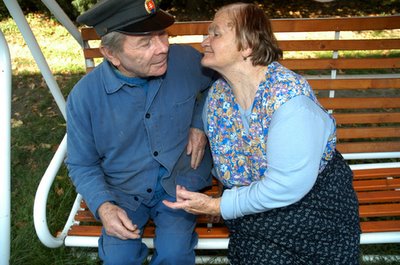 The Kiss, Olichov, 2005
By the side of the road near the village of Olichov is a big red fence. When we stop our car, the people of the Sanatorium are already waiting for us, waving, clinging on to the bars of the fence in their blue uniforms or simple dresses. They are the unwanted people of Slovakia, locked up behind bars.
Their clothes have their personal numbers on it, they are fed with all the calming-drugs and food that can be provided, but it would be too easy to condemn this all. The sun is shining, the people are laughing, touching our cheeks, holding our hands like we are their long lost sons and daughters. Or the children they could never have because they are sterilised.
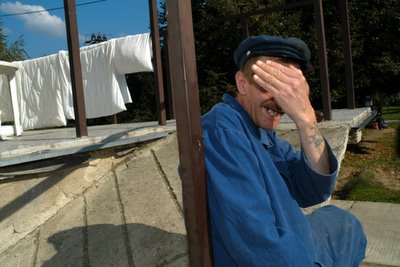
I take my time to make a picture of this man, he is drawling out of his black-teethed mouth, his blue uniform tells me he is number 663. While he is playing hide and seek with me, trying to avoid the camera while his smile getting bigger and bigger, I wonder how number 663 got his tattoo. Later, the nurse tells me he was married, had two little children and a house. When the lightning struck him and his brain was damaged his wife dropped him off at the sanatorium. They never saw her again.
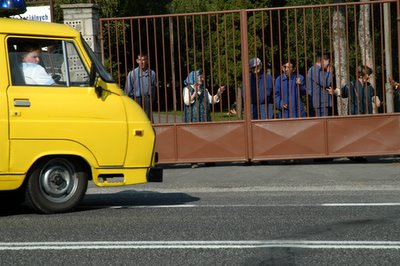 Later on the people stroll off, lie down on the grass to take a nap. Others go to the field to harvest the apples they grew, or sit on benches in the shade to listen to some music, hold hands, steel a kiss.
Subscribe to:
Posts (Atom)